
These are the further adventures of Dan Jones and Helen Trenchard, on their 12 month mission to boldly go where they'd not been before...KENYA!
Wednesday, 20 June 2012
Q: What will you miss most?
A: Our good Kenyan friends, chapatti, walking over the railway bridge, the friendliness of everyone. Learning Swahili with Lucy and Nick, going on adventures all the time, giraffes. Work-life balance. The monkeys who stole the sugar bowl from my office. A country where a cold day is almost the same temperature as a warm day in the UK. Rides on the back of pikis (motorbikes). Meeting new people constantly, and making friends with people we probably wouldn’t even meet back home. Elephants. Cute children tugging at my beard, people taking the time to find out how you are, wandering round South B. Huge, ripe avocadoes right outside my door for 20 bob (15p). Spending so much time with my loved one. Never having to wait for a bus (there’s no schedule, but there’s always one there). A big apartment. Strolling round Nairobi city centre on a Sunday. Feeling ‘light’ – few possessions, little need to buy things, no real obligations, freedom to do whatever. The support of fellow VSOs, the eagerness of people like us in a strange land to make friends and share experiences. Safaris, coconut beaches, Splendid Starlings, colourful fish, Kenyan pride, cooking on gas. Tusker beer, choma, Kenyans dancing at every opportunity, mangos.

Tuesday, 19 June 2012
Q: What are you most looking forward to?
A: European food and drink, seeing our friends and their children after a
year away, being able to drive around in a car, having a
fridge, living somewhere quieter. Roads, buses and trains that are more
predictable and more comfortable, beautiful architecture, clean air, wonderful gardens, public spaces that are safe and pleasant. Not
being stared at or shouted at, just being ignored, feeling ‘at home’. Pavements
and drains, baths, walking around at night, generally having more freedom to go
where and when I like, having a 'right to roam' - taking a walk in the countryside. Seeing VSO friends
already back in the UK, carpets, drinking water out the tap, working in an
environment I fully understand, autumn leaves.
Sunday, 17 June 2012
How to make Kenyan chapati
Posted by: Helen
A little sugar
A lot of vegetable cooking oil
1. Put all the flour in a big bowl. Mix ½ teaspoon of salt and 3 teaspoons of sugar in a cup of warm water, and add to the flour. Add 50g vegetable oil, plus another cup of warm water with nothing added. Mix it all up with your hands so the dough takes in all the flour. Be careful not to make it too sticky (add flour) or too flaky (add water).
2. Roll the dough out flat with a rolling pin or wine bottle, but not too thin. Use more flour to stop everything sticking together. Pour another tablespoon of oil over this chunky pancake and smooth it all over the top.
3. Cut the flattened dough into strips about 5cms wide. Wind each strip into a tight roll, pulling the ‘tail’ of each strip and pushing it into the centre of each roll, making a dimple. This keeps it all tightly wound. Each rolled up dough ball should be the size of a child’s fist.
4. Get your chapati pan ready. This could be the purpose-made, flat heavy iron pan, or a normal frying pan. The pan should NOT be non-stick, as the coating can be removed during cooking. Any thick-bottomed shallow pan that will really hold the heat should work, remembering that to be doing it Kenyan-style, you'll be using your hands to turn the chapati. Put a little oil in your pan with a tablespoon and give it a medium to high heat to prepare for shallow frying.
5. While your pan is heating up, roll your first dough roll into a chapati. ‘Not too thick, and not too thin’. It should be the size of a man’s outstretched hand. Jack rolled his dough into a perfect circle. Our first attempts looked more like the shape of Kenya (!) but practice makes perfect. Whatever the shape, you’re ready to fry.
6. When your pan is very hot, carefully place the flatten chapati dough onto the oiled pan and rotate it smartly with your outstretched fingers (careful!). After less than a minute you’ll see the cooked colour emerging through from the other side.
7. Flip it with the tablespoon and your hand and completely coat the just-fried side with (more!) oil using your spoon. Flip after a short time to do the same with the second just-fried side. The chapati will bubble up and brown in patches so keep smoothing it down with the back of the spoon.
8. When there are dark brown patches on both sides and you’ve flipped it 3 or 4 times your chapati is cooked. Each one should take less than 3 minutes to fry in the pan.
9. To conserve your fuel, and have more fun, ask a friend roll out the next dough ball while you’re cooking and switch duties once yours is cooked.
10. After 5 or 6 chapatis have been fried, dark flour residue in the pan can make chapatis look cooked before they are, so wipe the pan with a cloth and re-oil it.
 |
| This blog post is dedicated to Phil Borge who dared me to plunge into a Kenyan kitchen and emerge, recipe aloft, to tell the tale and share the joy. |
The humble and glorious chapati. A mainstay of East African culture and an essential part of any Kenyan feast. This blog post is written in praise and glory of the chapati, and shows you how to make them Kenya-style.
For those of you wondering why an Indian food came to be so important in East Africa, look no further than the British. Kenya’s colonial masters chose to build a railway connecting the East African interior (Uganda) with the Kenyan port of Mombasa for trade, access and…. well just because we could, really.
Dubbed ‘The Lunatic Line’ by Victorian commentator Henry Labouchere, it once spanned the region like a clanking iron snake, and still exists as ‘one of the world’s best train journeys’ even if the now much reduced network is in desperate disrepair. At time of writing the line is closed for maintenance work, although we were lucky enough to travel the Nairobi-Mombasa overnight journey three times last year (and escape with our lives). We found it to be an oddly charming colonial relic, complete with bunks, a dining car and frightening toilets.
Between 1896 and 1901, 38,000 Indian labourers were shipped over to Kenya to build the railway. It seems that local Kenyan workers were...'reluctant' to provide slave labour for this nutty British project. Instead, the railway was built by the Queen’s subjects from India. 6,000 of these railway workers who had survived the conditions, the diseases and Tsavo's man-eating lions stayed on and made a permanent home here. Kenya's Asian population contributes massively to Kenya's culture and (particularly) the economy to the present day. One of those contributions is our humble and delicious chapati.
Preferring their chapati’s heavy, thick and made with a lot of oil (and who wouldn’t?) Kenyans soon moved away from the thinner, healthier, Indian chapati and created their own. Always made for special occasions, ‘chapati’ or ‘chappo’ is the answer when asking most Kenyans about their favourite food. Many Kenyan friends and colleagues have happy memories working together in the kitchen with mother and siblings to make the dish. Dan and I eat many every week as they are just so tasty in a country where many of the staple foods don’t rock our boats.
Sold on street stalls all over Kenya, the Professional Chapati Makers (do they have a name?) have two (or more) pans on the go at once; they are hunched over, spinning one with each hand like a DJ at a turntable, and rolling out more dough with every spare second. This is all very impressive, because making one at a time was tricky enough…
Dan and I spent a recent evening in the lovely home of pals Kristen and Jack. We were there for our chapati lesson with Jack, and super fun it was too. We learned why personal trainer Jack often starts conversations about weight loss with clients by determining their ‘chapati intake’, by discovering exactly how much oil goes into Kenyan chapati. This, people, is why they taste so good. Big thanks to Kristen and Jack for such a fun time, and special thanks to Chef Sukura for his patient guidance, and sharing his mother's precious recipe with us all. You guys rock.
Between 1896 and 1901, 38,000 Indian labourers were shipped over to Kenya to build the railway. It seems that local Kenyan workers were...'reluctant' to provide slave labour for this nutty British project. Instead, the railway was built by the Queen’s subjects from India. 6,000 of these railway workers who had survived the conditions, the diseases and Tsavo's man-eating lions stayed on and made a permanent home here. Kenya's Asian population contributes massively to Kenya's culture and (particularly) the economy to the present day. One of those contributions is our humble and delicious chapati.
Preferring their chapati’s heavy, thick and made with a lot of oil (and who wouldn’t?) Kenyans soon moved away from the thinner, healthier, Indian chapati and created their own. Always made for special occasions, ‘chapati’ or ‘chappo’ is the answer when asking most Kenyans about their favourite food. Many Kenyan friends and colleagues have happy memories working together in the kitchen with mother and siblings to make the dish. Dan and I eat many every week as they are just so tasty in a country where many of the staple foods don’t rock our boats.
Sold on street stalls all over Kenya, the Professional Chapati Makers (do they have a name?) have two (or more) pans on the go at once; they are hunched over, spinning one with each hand like a DJ at a turntable, and rolling out more dough with every spare second. This is all very impressive, because making one at a time was tricky enough…
Dan and I spent a recent evening in the lovely home of pals Kristen and Jack. We were there for our chapati lesson with Jack, and super fun it was too. We learned why personal trainer Jack often starts conversations about weight loss with clients by determining their ‘chapati intake’, by discovering exactly how much oil goes into Kenyan chapati. This, people, is why they taste so good. Big thanks to Kristen and Jack for such a fun time, and special thanks to Chef Sukura for his patient guidance, and sharing his mother's precious recipe with us all. You guys rock.
 |
| Dinner at Kristen and Jack's = good times. |
Roll up your sleeves, and let’s get started. We’re making chapati for four people.
Ingredients
500g plain flour
2 cups of warm water
A little salt2 cups of warm water
A little sugar
A lot of vegetable cooking oil
Method
1. Put all the flour in a big bowl. Mix ½ teaspoon of salt and 3 teaspoons of sugar in a cup of warm water, and add to the flour. Add 50g vegetable oil, plus another cup of warm water with nothing added. Mix it all up with your hands so the dough takes in all the flour. Be careful not to make it too sticky (add flour) or too flaky (add water).
 |
| Dan gets stuck in |
 |
| LOTS of oil |
 |
| Give it a mix |
2. Roll the dough out flat with a rolling pin or wine bottle, but not too thin. Use more flour to stop everything sticking together. Pour another tablespoon of oil over this chunky pancake and smooth it all over the top.
 |
| Roll it out |
 |
| More oil |
 |
| Cutting into strips |
 |
| Tight little rolls |
 |
| Nine chapatis, ready to be born |
 |
| Jack shows us the chapati pan |
 |
| Spinning the chapati |
7. Flip it with the tablespoon and your hand and completely coat the just-fried side with (more!) oil using your spoon. Flip after a short time to do the same with the second just-fried side. The chapati will bubble up and brown in patches so keep smoothing it down with the back of the spoon.
 |
| Smoothing on the oil |
8. When there are dark brown patches on both sides and you’ve flipped it 3 or 4 times your chapati is cooked. Each one should take less than 3 minutes to fry in the pan.
9. To conserve your fuel, and have more fun, ask a friend roll out the next dough ball while you’re cooking and switch duties once yours is cooked.
 |
| Keep cooked chapatis covered until you’re ready to eat |
11. Cut into friendly quarters and arrange on a dish. Serve with your favourite meat stew, vegetable dish or fish if you're feeling coastal.
 |
| Ta-daaa! All ready |
We had our chapattis with Kenyan favourite Ndengu, which are green grams (like lentils) cooked with grated carrot, peppers, skinned tomatoes and coriander. Thanks Kristen. You can even add coriander and grated carrot to the dough to make seriously tasty chapattis. We’ll try that next time.
 |
| Kristen's homemade ndengu. The perfect partner for our chapatis. |
Thursday, 14 June 2012
Carry on camping...in a volcano
Posted by: Dan
Finally! A chance to go camping! After 11 long months of not sleeping in a tent, a brief but brilliantly memorable trip to Mount Suswa was the perfect anecdote. Here’s a brief but brilliant blog post in memory of my favourite volcano.

Suswa, a not-so-long-dormant volcano in the great rift valley (it is believed to have erupted less than two hundred years ago), first got on our radars thanks to a recommendation from fellow volunteer Aurelia. She and her fiancée Tom loved this magical place so much that they went back numerous times, created a website for the local Maasai guide, and even got engaged there. They raved about the boiling hot steam vents, the verdant green slopes, and the astonishing lava caves filled with baboons and bats. We were sold.

Probably my favourite thing about Mount Suswa was that it felt like a real Adventure. It was, quite literally, well off the beaten track. In fact, without our friends and fellow adventurers Marc and Veronica – and their lovely 4x4 landrover – we couldn’t have done it (thanks guys!).
We met our charming and excellently-named Maasai guide Daniel in the small town of Maai Mahiu, where he jumped in and guided us as we drove off-road for hours up the increasingly rocky and decreasingly road-like slopes of Suswa. Marc proved his ability to stay calm despite the bangs, groans and protests coming from his car, as we drove up over not-so-old lava flows and into the outer crater.
Suswa has a unique double crater structure. Astonishingly, in this most remote of places, a community thrives. The plateau between the outer and inner craters is the home of Maasai, and the fertile land is dotted with manyattas (homesteads), crop fields and volcanic steam vents which the people have learned to channel into water storage tanks for domestic use.
We drove on, finally reaching the very edge of the inner crater, where we parked up, put up tents, and gazed out over the sacred “lost island” of lush forest (filled with leopards – and possibly dinosaurs) that occupies the moat-like inner crater. And we looked upwards at the dramatic peak of Suswa looking down on us from amongst the clouds. Breathtaking.


What followed was 24 hours of exploration, caves, bat crap, hiking, toasting marshmallows, snuggling in our tents, dodging black mambas, and proudly reaching the 2,356-meter summit of the mountain.
They say a picture is worth a thousand words, so instead of writing a thousand words (I could easily, I’m being very disciplined right now) – here’s some more of my favourite pictures from our mini adventure….
(just click play)
As Daniel the Maasai proudly told us, Suswa's baboons and bat caves have featured (along with the Maasai themselves) in a BBC Documentary “The Great Rift”. You can see a short clip on the BBC website here, or settle down to watch the whole awesome episode on Youtube here. I know my wildlife-loving brother is quite jealous right now - sorry Mike!

With thanks:
To Aurelia for the recommendation.
To Trixie for the tent.
To Veronica and Marc for being great company, and to Marc especially for his steely nerve and daring driving.
And to Daniel, for being such a warm host and knowledgeable guide. If you’re in Kenya or planning a visit, we urge you to get in touch with him for a truly memorable adventure. His website is danielmountsuswa.wordpress.com.
Finally! A chance to go camping! After 11 long months of not sleeping in a tent, a brief but brilliantly memorable trip to Mount Suswa was the perfect anecdote. Here’s a brief but brilliant blog post in memory of my favourite volcano.

Suswa, a not-so-long-dormant volcano in the great rift valley (it is believed to have erupted less than two hundred years ago), first got on our radars thanks to a recommendation from fellow volunteer Aurelia. She and her fiancée Tom loved this magical place so much that they went back numerous times, created a website for the local Maasai guide, and even got engaged there. They raved about the boiling hot steam vents, the verdant green slopes, and the astonishing lava caves filled with baboons and bats. We were sold.

Probably my favourite thing about Mount Suswa was that it felt like a real Adventure. It was, quite literally, well off the beaten track. In fact, without our friends and fellow adventurers Marc and Veronica – and their lovely 4x4 landrover – we couldn’t have done it (thanks guys!).
 |
| Daniel the Maasai |
Suswa has a unique double crater structure. Astonishingly, in this most remote of places, a community thrives. The plateau between the outer and inner craters is the home of Maasai, and the fertile land is dotted with manyattas (homesteads), crop fields and volcanic steam vents which the people have learned to channel into water storage tanks for domestic use.
 |
| Breathing in the steam |
 |
| Marc examines a water capture 'system' |
We drove on, finally reaching the very edge of the inner crater, where we parked up, put up tents, and gazed out over the sacred “lost island” of lush forest (filled with leopards – and possibly dinosaurs) that occupies the moat-like inner crater. And we looked upwards at the dramatic peak of Suswa looking down on us from amongst the clouds. Breathtaking.


What followed was 24 hours of exploration, caves, bat crap, hiking, toasting marshmallows, snuggling in our tents, dodging black mambas, and proudly reaching the 2,356-meter summit of the mountain.
They say a picture is worth a thousand words, so instead of writing a thousand words (I could easily, I’m being very disciplined right now) – here’s some more of my favourite pictures from our mini adventure….
(just click play)
As Daniel the Maasai proudly told us, Suswa's baboons and bat caves have featured (along with the Maasai themselves) in a BBC Documentary “The Great Rift”. You can see a short clip on the BBC website here, or settle down to watch the whole awesome episode on Youtube here. I know my wildlife-loving brother is quite jealous right now - sorry Mike!

With thanks:
To Aurelia for the recommendation.
To Trixie for the tent.
To Veronica and Marc for being great company, and to Marc especially for his steely nerve and daring driving.
And to Daniel, for being such a warm host and knowledgeable guide. If you’re in Kenya or planning a visit, we urge you to get in touch with him for a truly memorable adventure. His website is danielmountsuswa.wordpress.com.
Thursday, 31 May 2012
Love and Marriage
Posted by: Helen
One of the best things about living in a new culture is realising all the opinions that you’ve built up over a lifetime, might just be complete rubbish. Life here exposes my beliefs as one of many possible versions. Mine are simply local to the society I was raised in.
One of the best things about living in a new culture is realising all the opinions that you’ve built up over a lifetime, might just be complete rubbish. Life here exposes my beliefs as one of many possible versions. Mine are simply local to the society I was raised in.
Discovering new ways of looking at the world is thrilling; today I’d like to show you how 11 months of conversations have shown me there’s no single view of marriage. Join me for a tale of love and marriage that might just change my life...
_________________________________________________
I am married in Kenya
 I’m at work, telling an office-mate about the weekend trip that Dan and I had taken together, and she looks more and more confused. Finally, she asks: but why do you call Dan your boyfriend? Are you not serious about him? Very serious! I assure her, we’ve been together for almost 10 years. Her response is simple: then he is your husband.
In Kenya’s conservative society, this bride price transaction gives societal cover for the couple to now live together, have children, and save for the big white (legal) wedding every Kenyan lady dreams of. She has been bought for her husband’s family, to which she now belongs. A married woman leaves her own family forever; her relatives cannot stay overnight in their house, for most tribes her children belong to her husband’s family, and if she socialises with her own parents, it is never in the company of her husband. Telling my married male colleague about plans I had for my parent’s visit back in March, I described the trip Dan and I would take with them. This is so strange in my culture! He exclaimed, You mean you’ll walk around with YOUR parents, in public, the four of you? He actually shivered.


_________________________________________________
I am married in Kenya
 I’m at work, telling an office-mate about the weekend trip that Dan and I had taken together, and she looks more and more confused. Finally, she asks: but why do you call Dan your boyfriend? Are you not serious about him? Very serious! I assure her, we’ve been together for almost 10 years. Her response is simple: then he is your husband.
Here in Kenya, the words ‘husband’ and ‘wife’ show a commitment made between two people not necessarily joined by law. In fact most Kenyans I know started their married life not at a courthouse, but at a bride price negotiation, a crucial settlement between families. The groom’s family pay bride price, or an amount of livestock in exchange for her hand in marriage (or sometimes the cash equivalent of 10 goats = 1 cow). I first learnt about this, when writing Monicah’s story last year.
(‘Boyfriend’ seems to signal a relationship that’s new, or something extra-marital. If I mention my boyfriend, Kenyans have been moved to ask me, so do you have a husband (as well)?).
(‘Boyfriend’ seems to signal a relationship that’s new, or something extra-marital. If I mention my boyfriend, Kenyans have been moved to ask me, so do you have a husband (as well)?).
In Kenya’s conservative society, this bride price transaction gives societal cover for the couple to now live together, have children, and save for the big white (legal) wedding every Kenyan lady dreams of. She has been bought for her husband’s family, to which she now belongs. A married woman leaves her own family forever; her relatives cannot stay overnight in their house, for most tribes her children belong to her husband’s family, and if she socialises with her own parents, it is never in the company of her husband. Telling my married male colleague about plans I had for my parent’s visit back in March, I described the trip Dan and I would take with them. This is so strange in my culture! He exclaimed, You mean you’ll walk around with YOUR parents, in public, the four of you? He actually shivered.
My two oldest male colleagues have wives who have given birth to 6 children between them, but neither couple is lawful. My legally married (female) colleague is shocked by this, and believes that no woman should settle for bride price alone. Those guys are providing no security for their wives! She tells me that either man could choose another woman to be legal Wife Number One at any time, leaving the mother of their children to be only a second wife, a much more lowly position.
Four wives are better than one

Polygamy is legal here, and has been a traditional part of Kenyan culture for generations. Whilst my (urban) Kenyan friends often talk about it in the past tense (I’m always being told, my Grandfather had 3/9/12 wives), or as something which now only exists in ‘rural areas’ (read: in a less educated Kenya), the practice is still admired by many. The Chairman of a local branch of my organisation smiles at me and says: When I have more money, I will take a second wife. I ask him why he needs more than one, and his answer is based firstly on economics, he tells me:
Two wives can work more, have more children and a bigger family contributes more income. Once I can afford another wife, I will take one. Plus, we Kenyan men need sex. How do the British men last 9 months when their wife is pregnant?
(Sex during pregnancy is clearly taboo for this marriage).
It seems that a discussion on marriage is not complete without also looking at children. Let me explain how the questions of how many children, and how they are raised cut right to the heart of love and marriage in Kenya.
Families: bigger the better
Kenyan families have always been large, and polygamy is certainly a factor. The common theme in tribal beliefs seems to be that children equal status and money. In the 1970s, the average Kenyan mother had 8 children (!!), and today’s average is still 4.8. Sometimes it seems that having just one child is as good as none. For a marriage to work, they must arrive in large numbers.
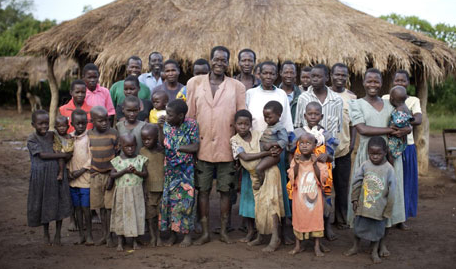
My colleague tells me how tough life is at the moment, how tight their money is stretched by raising children from her husband’s marriage with a late wife, and some local children she has taken in from her church. But there will be another, in December, she sighs, patting her tummy. My unasked question is: but why another when you struggle to feed those you have? She must have seen it on my face, and so replies, We only have one child together, and it is not enough.
Childlessness is a sensitive subject anywhere in the world, but a curse in Kenya. It seems that all married women have children, perhaps because the familial agreement is rescinded if children don’t follow on swiftly. For the wealthy, there are other options it seems. Sitting in the maternity ward, carefully nursing her newborn baby, my colleague’s wife was approached by a well-off couple. They offered us money for our child! he told me, still in shock.
How to have it all

Having many children is important at every level of Kenyan society: the glossy, successful female CEOs and Senior Executives profiled in the newspaper are always mothers. In fact, it’s much easier to be a working mum in Kenya, than for mothers in the UK. Kenyan women can hire round-the-clock, live-in ‘help’ for housework and childcare for as little as 7000 bob in Nairobi, much less in other parts of Kenya. For less than £50 a month, women can go back to work. No trying to ‘do it all’ in this culture, juggling childcare, housework and impressing the boss - women of all income levels are supported back into the workplace with the minimum of fuss: even our office cleaner explained why she was run so ragged this month, because you know I am operating without a housegirl.

 My 20-something male colleagues model themselves on ‘western’ families: one husband, one wife, both having a career. In previous generations, education could only be afforded for a ‘first born’ or perhaps only for sons, but my colleagues know investing in senior and higher education for the ir children is vital, so maybe they can only afford 2 or 3. Three graduates is better for the family than a massive brood of 12-year-old school leavers. My colleague says, if I am blessed with only girls I am still a happy man. They talk about their wife’s needs; they change nappies, and answer the night-time cries.
While this situation seems to scream of female empowerment, there are several thoughts lurking beneath the surface which trouble me, because they move so far away from my home culture:
Firstly) do men marry for the extra income? Margins are so tight for the average Kenyan family that the ‘double income’ we see as a sign of wealth in the UK, can be essential here for basic survival.
Secondly) What about these young women who live in strange homes performing menial domestic tasks all day for just over $1 a day in a big city? What are their dreams? They daren’t dream of education, not in a culture without washing machines or ready meals. My housegirl left to get married, grumbles a colleague, my sister is sending us a new girl from our rural area. I ask him why put a scared teenager on a bus to Nairobi for the first time, when there’s such unemployment in this city? He looks at me like I’m stupid. Because the girl who raises my children must speak my local language, of course!
And here we come to thought number 3) which troubles me. I’m told that many women hire help for the house, simply so their focus doesn’t stray from their husband. A Kenyan friend articulates what I’ve seen everywhere in Kenya: men expect many children from their marriage, but are not expected to help raise them. And every minute a woman spends attending to the child in the home, is time not spent attending to her husband’s needs. I’m sure this is a grumble in marriages worldwide, but this economy provides a ‘solution’. If the housegirl takes care of all chores, our working Kenyan mother has no excuse not to meet all the marital duties her husband expects of her, especially the business of making more babies, whether she chooses to or not.
Does marriage burden women?
My opinions are simply a product of where I come from, I know that. And I try not to leap to conclusions, to see injustice everywhere - I know I'm not a cultural expert. But it's difficult; from all these conversations, I start to form an opinion that marital duties in Kenya are a real burden placed on women. Allow me to tell a story to back up my claim.
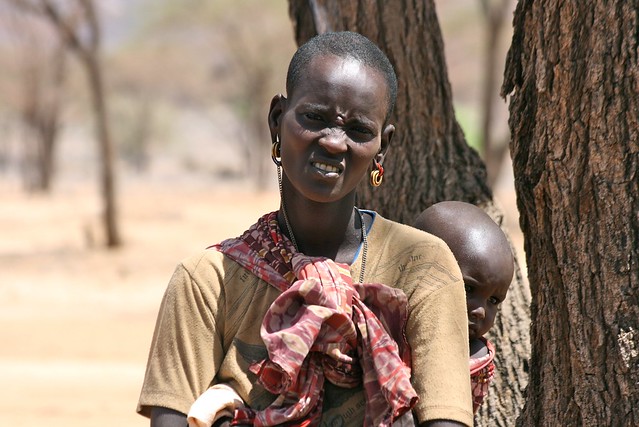
Babies in Kenya are carried on mothers' backs, within a kanga or lesso (piece of fabric) tied around her body. My colleague describes what happens when women from her village board the matatu (public service minibus), but forget the child. Stooping down to quickly squeeze onto the tiny vehicle, the child’s head resting on her back is clanged violently into the metal door frame. Everyone in the matatu is allowed to slap the mother for being so stupid. I ask her how often this happens. All the time, rural women carry their baby for miles so forget it is there. Unlike the matatu passengers, I didn’t judge the women. It was no stretch of my imagination to see a tired young wife, carrying her sixth child. She has no voice in when or how she reproduces. Slung onto her back, the baby is not a precious life, but simply a burden to be carried.
Let me share a more shocking example from a recent new item. A newborn baby was found in the fields of Kalifi county, seriously disfigured and with an unattached hand; this three-day-old child had been abandoned and then mauled by dogs. The baby's 23-year-old mother was found and charged. She blamed her crime on her husband - things were bad between them, and she couldn't cope with another child. Officials actually pleaded in the paper for mothers who felt overburdened to please take unwanted children to adoption services, and not simply throw them away. It seems this is not an isolated case.

A VSO friend suggests a solution to these burdens: polygamy. She tells me her colleague is delighted that her husband is taking a second wife. This younger woman will be subservient to her, do most of the housework, and bear the full load of duties in the marital bed. She is so pleased! my friend tells me. Is this the true definition of having it all?
Whatever your views on polygamy, there is a view that taking another wife only legitimises what happens anyway, as someone commented to me recently: there is no expectation of fidelity within a Kenyan marriage. I’ve seen with my own eyes how some Kenyan men don’t even pretend to be faithful to the mother of their children. It troubles me that again this burdens their wives back home. In a country where 6% of the population is HIV positive, extra-marital sex is the top reason in some reports for why Kenya has a higher HIV prevalence rate than some of its African neighbours. Most HIV-positive Kenyans are women, but the vast majority have only ever had one sexual partner: their husband.
Times are changing
Opinions differ on whether the situations I describe belong to an older Kenya, or if they now exist only in rural areas, and I doubt my whistle-stop tour of gender politics will find a definitive answer. I can only report what I’ve been told.
But I'm seeing another very clear theme come through: younger, urban, educated couples are throwing off traditional beliefs and with it the burden on women I’ve described.
But I'm seeing another very clear theme come through: younger, urban, educated couples are throwing off traditional beliefs and with it the burden on women I’ve described.
 My 20-something male colleagues model themselves on ‘western’ families: one husband, one wife, both having a career. In previous generations, education could only be afforded for a ‘first born’ or perhaps only for sons, but my colleagues know investing in senior and higher education for the ir children is vital, so maybe they can only afford 2 or 3. Three graduates is better for the family than a massive brood of 12-year-old school leavers. My colleague says, if I am blessed with only girls I am still a happy man. They talk about their wife’s needs; they change nappies, and answer the night-time cries.
Another clear step away from older beliefs is taken by two people of different tribes. These couples have less shared traditions, no truck with mother-tongue. They raise their children in Swahili, to see themselves as Kenyan first and foremost, with no ethnic bias. They are already open-minded by dint of their union, and they talk about... love.
There are statistics to back-up my belief. Once the nation with the fastest population growth on earth (from 2.9 million in the 1920s to 30 million in the 1990s), the 2000s saw Kenyans having many fewer children. There are 40 million people in Kenya today.
Are we seeing Kenya move closer to what I (and the UK) define as marriage? Am I allowed to see that as a positive move, towards greater equality and with less burden on women? If it gives me ‘hope,’ do I sound arrogant?
I won’t pretend that the Global North has love and marriage all figured out, when two thirds of British marriages fail. And I do understand how marriage is vital to provide for women in a society in which they cannot legally own land. But I still prefer the equality integral in my definition of the word ‘marriage’, can’t let go of my sense of right and wrong.
Some cultural difference are harmless though, and I happily adapt to make things easier for everyone. At first it was strange to call Dan ‘my husband’, having never tied the knot back home. But, weirdly, I’ve found I like demonstrating the commitment that the word means here. It makes me wonder whether I’ll miss using the word when we return to the UK, and how to demonstrate my commitment to him in a way that makes sense in my home culture...
...no promises ;o)
Monday, 28 May 2012
Our TV debut
Monday: My organisation received an invite to an event at the UN compound, in Gigiri, north Nairobi. It’s tomorrow, says my boss. The President is speaking. Would you like to go? I leapt at the chance, of course, and also invited Dan, lest I feel the wrath of a man who loves a little international politics…
 We met up with a few VSOs who are in placement with various UN agencies, and generally marveled at the posh coffee and well-paid, well-dressed people you find in the UN’s only global HQ located in the developing world. It was surely for that reason that big-wigs from UNDP had chosen Nairobi to launch the first ever Africa Human Development Report today, this one on food security.

Tuesday: We sat together on the matatu heading north through hilly, leafy suburbs (the OTHER Nairobi), wondering if Kenyan President Mwai Kibaki would actually show. I think he will! says Dan, spotting policemen standing to attention every 100 yards along the road in readiness.
The UN compound is the global headquarters of UN Habitat and UN Environment Programme. It’s green, landscaped, full of white people. Through a light security check (a British passport goes a long way), and we were striding between flags of the world, UN lanyards swinging from our necks. We decided to not actually step onto the red carpet laid for the president and instead kind of skirted round it.
 We met up with a few VSOs who are in placement with various UN agencies, and generally marveled at the posh coffee and well-paid, well-dressed people you find in the UN’s only global HQ located in the developing world. It was surely for that reason that big-wigs from UNDP had chosen Nairobi to launch the first ever Africa Human Development Report today, this one on food security.
The launch of the report was in an enormous room, unmistakably UN-y. Maybe 500 people from many, many different nations were seated at long tables with headphones for translation and microphones for question-time. We sat down sheepishly, feeling like SUCH BLAGGERS, and enjoyed an opening performance of Kenyan dancing. As Kibaki entered the room from the back, the room fell deathly silent, everyone craning their necks to watch him walk from the back of room, surrounded by very burly security.
There was a fancy video, and interesting speeches, highlighting the causes of food insecurity, which leads to famine. The UNDP is currently led by its first female Administrator, Helen Clarke, who was President of New Zealand for 9 years. I thought she was excellent.
I took away many things from the speeches, but mainly -
- Famine no longer occurs in Latin America and Asia. Sub-Saharan Africa has just as many abundant natural resources.
- It is bad governance, weak institutions and poor policy-making that are the main reason why food is insecure; not climate and not drought.
- A policy of educating women is one of the main approaches in building resilience to whatever the weather throws at you.
- Young people are choosing not to farm, but employing new technologies will show them it is not the back-breaking industry of previous generations.
- Hungry people cannot learn, cannot work, cannot grow the economy or build the nation; food security is vital for Africa.
Then Kibaki stood up to speak, and a uniformed military officer moved to stand behind him. My Kenyan friends reminded me that a car accident and subsequent stroke have robbed him of the energetic way he used to give speeches. But it was still strange to see a national leader with less public-speaking skills than the average pastor in a church on Sunday. He defended his government’s record on food security and thanked the UN for their efforts in compiling the research. Then there were smiles, handshakes, photos and he was gone.
We left soon after to use the facilities and get a tour of the buildings, sculptures and salad-bars of the UN compound from the lovely Harvey Garcia, fellow VSO who works with UNIDO on coastal pollution in East Africa.
Then having heard all about food insecurity and the perilous position of Africa’s starving poor, all the guests sat down to a lavish banquet. No joke. After a few wry comments on this startling juxtaposition, we tucked greedily into an amazing buffet. There was even a PUDDING TABLE. It was, as UN-ers Andrea and Amy commented, a good day to visit the UN.
Sunday: I saw you on TV! says friend Lucy. The only people featured on the NTV report were President Kabaki, and you guys! I saw you several times in the report. We couldn't believe it, but a quick google proved her right. The realisation that us INTERLOPERS were the focus for the audience-cam AND also caught in the back of shot coming back from the loo on national television made us giggle for a good long while.
Screen shot below, or click the video further down to learn more about the event, and play 'Spot the Jonchards'…
Screen shot below, or click the video further down to learn more about the event, and play 'Spot the Jonchards'…

Thursday, 24 May 2012
Kenya's Banksy Vs The Vultures
Nairobi can often seem an ugly, scruffy city filled with rubbish, traffic and smog. It’s not a city that is immediately lovable to the outside eye, and most of it won’t be winning any prizes for architecture or culture any time soon.
Despite this, Helen and I have learned to love our host city. Particularly at weekends, when it’s quieter, there’s less stress, and you can do a bit more “wandering” and a bit less “marching purposefully and glowering at everyone who hassles you”. Too many people give up on Nairobi too soon, or decide that they will simply avoid the city centre completely because it’s “unsafe”, and instead stay in the posh, white expat areas of Westlands, Karen or Runda.
Wandering through the CBD (central business district, as they call the city centre) on a recent Saturday, we came across something which made us stop and stare, and which filled me with joy. It was a series of graffiti murals on the walls around City Market, the big meat market in a run-down part of Nairobi.


The murals were painted in the middle of the night in March this year, and despite the anger and efforts of city hall, have managed to remain so far. They depict, basically, Kenya’s biggest problem: Terrible, corrupt leadership.

I don't pretend that British politicians are all whiter than white. All our UK readers will know this isn't true, after recent scandals over mis-use of the expenses system and disturbing collaboration between politicans and sections of the media. But equally, the public outrage caused by these scandals and the punishments handed out do show that we value good, transparent, public-serving leadership very highly. What if we didn't have that? What if we couldn't rely on our politicians at all?
It can be frustrating to talk to some Kenyans about politics, and hear them talk about voting loyally along tribal lines, and worse, to sense the feelings of helplessness, apathy, inevitability when they talk about politicians. I feel like too many Kenyans just think that corruption, poor leaders, suffocating tribalism and divisive rhetoric are just “the way things are, and the way they’ll always be”. It’s this that feels like Kenya’s biggest challenge, not poverty or famine.
So it was a beautiful, wonderful thing to see these protest murals. They depict MPs literally as vultures, scavenging off the hard work of ordinary Kenyans. I think it’s the perfect analogy. In Kenya, people often refer to politicians “eating”, and its exactly what happens – not just that they have big, fat bellies from plenty of food in a country which knows what it means to starve. But also that they “eat” the money and resources meant for public good – roads, schools, hospitals. Instead, this money frequently gets siphoned off, misappropriated, or simply vanishes into thin air, into the pockets of Kenya’s “leaders”.

After the tribal violence at the last elections, incited and encouraged by Kenya’s top politicians, which saw over a thousand people killed and hundreds of thousands displaced, many Kenyans are sick to death of things being the way they are.
Another part of the mural lists the many scandals that have hit the headlines over recent years, each of them adding to a picture of corrupt, self-serving, inept politicians. In the list are the Goldenberg and Anglo Leasing scandals made famous in Michela Wrong’s phenomenal book “It’s Our Turn To Eat”, about Kenya’s former anti-corruption tsar and whistleblower, John Githongo (I cannot recommend this book highly enough!). Anglo Leasing was one of several phantom companies who were awarded Government contracts at massively inflated prices, despite not existing and without any public procurement competition. It is estimated that through these companies, $600 million of public funds were fraudulently misappropriated by top Government ministers, allegedly including the then Vice President, Finance Minister and Justice Minister. Githongo came to the conclusion that this corruption went all the way to the top, and was at least partly intended to finance President Kibaki’s re-run campaign at the 2007 elections.
Finally, on the right hand side of the mural is a list of the “leaders Kenyans want”, listing the qualities that they should look for when casting their vote at the next elections.

As the campaigns for the next Kenyan General Election in March 2013 heat up, the newspapers are full of the political machinations and manoeuvrings of MPs and those seeking to be the country’s next President. Tribalism still seems to dominate the power struggles, even though the newspapers here are self-censoring and never mention tribe. Four of Kenya’s leading figures, including two Presidential hopefuls, await confirmation of their trial date for crimes against humanity at The Hague, accused of inciting the 2007/8 post-election violence. And it’s hard not to see the delaying of the elections to March 2013 (rather than August or December this year, as originally planned) as simply MPs wanting a few more months of their world-beating salaries (a recent expose in the papers here suggested that they earn about £6,300 a month in salary and “allowances”, and most of it is tax-free). Talking to our Kenyan friends here, we feel depressed that more violence, like that at the last election, seems increasingly likely.
But when you see murals like these, you’ve got to have hope. Hope that Kenyans know what they want, know what they need, and will demand the Kenya they deserve, in the end.

I've just spotted that The Guardian wrote a great piece about these murals – have a read:http://www.guardian.co.uk/world/2012/mar/21/kenya-graffiti-artists-politicians-vultures
Despite this, Helen and I have learned to love our host city. Particularly at weekends, when it’s quieter, there’s less stress, and you can do a bit more “wandering” and a bit less “marching purposefully and glowering at everyone who hassles you”. Too many people give up on Nairobi too soon, or decide that they will simply avoid the city centre completely because it’s “unsafe”, and instead stay in the posh, white expat areas of Westlands, Karen or Runda.
Wandering through the CBD (central business district, as they call the city centre) on a recent Saturday, we came across something which made us stop and stare, and which filled me with joy. It was a series of graffiti murals on the walls around City Market, the big meat market in a run-down part of Nairobi.


The murals were painted in the middle of the night in March this year, and despite the anger and efforts of city hall, have managed to remain so far. They depict, basically, Kenya’s biggest problem: Terrible, corrupt leadership.
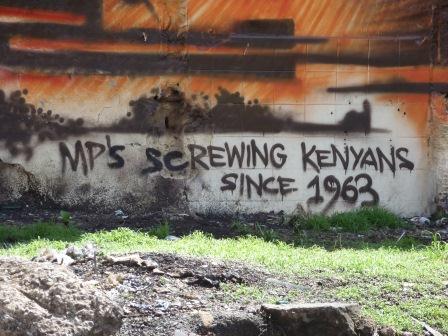
I don't pretend that British politicians are all whiter than white. All our UK readers will know this isn't true, after recent scandals over mis-use of the expenses system and disturbing collaboration between politicans and sections of the media. But equally, the public outrage caused by these scandals and the punishments handed out do show that we value good, transparent, public-serving leadership very highly. What if we didn't have that? What if we couldn't rely on our politicians at all?
It can be frustrating to talk to some Kenyans about politics, and hear them talk about voting loyally along tribal lines, and worse, to sense the feelings of helplessness, apathy, inevitability when they talk about politicians. I feel like too many Kenyans just think that corruption, poor leaders, suffocating tribalism and divisive rhetoric are just “the way things are, and the way they’ll always be”. It’s this that feels like Kenya’s biggest challenge, not poverty or famine.
So it was a beautiful, wonderful thing to see these protest murals. They depict MPs literally as vultures, scavenging off the hard work of ordinary Kenyans. I think it’s the perfect analogy. In Kenya, people often refer to politicians “eating”, and its exactly what happens – not just that they have big, fat bellies from plenty of food in a country which knows what it means to starve. But also that they “eat” the money and resources meant for public good – roads, schools, hospitals. Instead, this money frequently gets siphoned off, misappropriated, or simply vanishes into thin air, into the pockets of Kenya’s “leaders”.

After the tribal violence at the last elections, incited and encouraged by Kenya’s top politicians, which saw over a thousand people killed and hundreds of thousands displaced, many Kenyans are sick to death of things being the way they are.
Another part of the mural lists the many scandals that have hit the headlines over recent years, each of them adding to a picture of corrupt, self-serving, inept politicians. In the list are the Goldenberg and Anglo Leasing scandals made famous in Michela Wrong’s phenomenal book “It’s Our Turn To Eat”, about Kenya’s former anti-corruption tsar and whistleblower, John Githongo (I cannot recommend this book highly enough!). Anglo Leasing was one of several phantom companies who were awarded Government contracts at massively inflated prices, despite not existing and without any public procurement competition. It is estimated that through these companies, $600 million of public funds were fraudulently misappropriated by top Government ministers, allegedly including the then Vice President, Finance Minister and Justice Minister. Githongo came to the conclusion that this corruption went all the way to the top, and was at least partly intended to finance President Kibaki’s re-run campaign at the 2007 elections.
Finally, on the right hand side of the mural is a list of the “leaders Kenyans want”, listing the qualities that they should look for when casting their vote at the next elections.
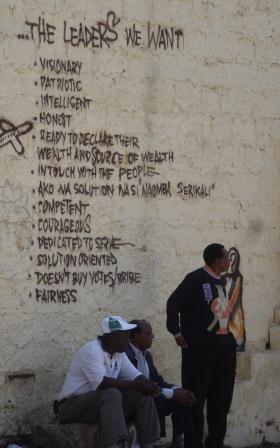
As the campaigns for the next Kenyan General Election in March 2013 heat up, the newspapers are full of the political machinations and manoeuvrings of MPs and those seeking to be the country’s next President. Tribalism still seems to dominate the power struggles, even though the newspapers here are self-censoring and never mention tribe. Four of Kenya’s leading figures, including two Presidential hopefuls, await confirmation of their trial date for crimes against humanity at The Hague, accused of inciting the 2007/8 post-election violence. And it’s hard not to see the delaying of the elections to March 2013 (rather than August or December this year, as originally planned) as simply MPs wanting a few more months of their world-beating salaries (a recent expose in the papers here suggested that they earn about £6,300 a month in salary and “allowances”, and most of it is tax-free). Talking to our Kenyan friends here, we feel depressed that more violence, like that at the last election, seems increasingly likely.
But when you see murals like these, you’ve got to have hope. Hope that Kenyans know what they want, know what they need, and will demand the Kenya they deserve, in the end.

I've just spotted that The Guardian wrote a great piece about these murals – have a read:http://www.guardian.co.uk/world/2012/mar/21/kenya-graffiti-artists-politicians-vultures
Subscribe to:
Posts (Atom)