Pages

Wednesday, 12 October 2011

Up The Mountain With Mohammed

Mount Kenya: second highest mountain in Africa, the peaks are the highest point in Kenya, at 5000 metres above sea level and covered in snow all year round. The country of Kenya is named after the mountain and it retains an important place in the beliefs of many tribal cultures…

Those of you who know Dan and I well, will be surprised to learn that our aim for this recent trip was not to summit the mountain, but just to climb part of the way up.  Invited to join a trip to the Mount Kenya National Park by a VSO volunteer living nearby, we discovered just how much of an adventure it could be to even climb half-way....

Presenting: a mountain adventure
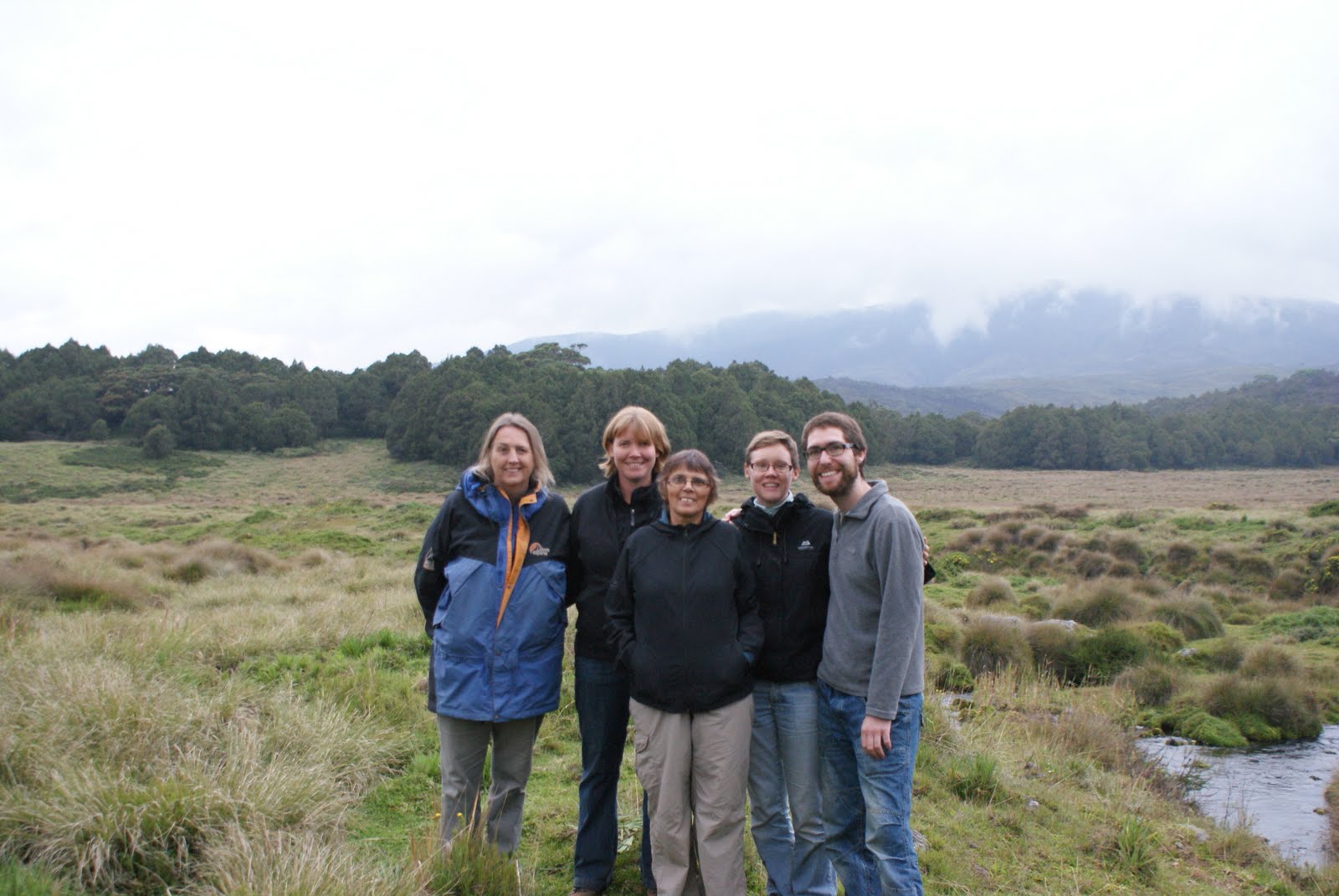
Featuring: Sally, Tara, Liz, Helen and Dan
Friday

A 6am start, we took a 4 ½ hour ‘express-cab’ journey from Nairobi to the mountain town of Chogoria – it cost 500 bob or £3.50, and took us out of the smog for the first time in a month, past unbelievably green rice fields and tea crops.  We arrived and joined our fellow VSOs for lunch in the shade and met Mohammed, the trek leader. 

This was our first experience of assisted trekking, a cross between tour-guiding and mountain-leading.  For the next 3 days we would be relying on a local crew to show us the way, carry our tent, encourage us and cook for us so all we focus on is: the climb.  In order to hike some of the prettiest trails in the park and gain some real height in just one weekend, we were to travel the first 33kms of the journey by car – we had been told ‘4x4 required’.

Climbing into the Landrover after lunch, a quick count revealed that the 5 of us trekkers were to be supported by a crew of 8 Kenyan guys, led by Mohammed.  We sat in the front, the guys in the back, feeling excited to be on our way and got our first look at the sticker that boasted: This vehicle is protected by the blood of Jesus Christ.  

And thank goodness it was.  The tarmac disappeared immediately, giving way to steep earth tracks that led to the gates of the National Park, and from that point the road continued through thick bamboo forests all the way to our first overnight spot.

The 3 hour journey which followed stretched my personal definitions of ‘road’, ‘danger’ and ‘car accident’.  The deeply rutted tracks and lake-sized puddles were deftly negotiated by our driver, Chris, who tackled each ‘sticky patch’ with gusto, his hands guiding the steering wheel so fast they blurred.  Only with attack, speed and sharp changes in direction could the road be conquered.  Back home they would have closed the road, or at least given us seatbelts….

The car seemed to lean into every 45 degree angle and threaten to topple twice every minute.  Our hands gripped the bar, our hearts were in our mouths, our stomachs disappeared and we swung violently from side to side, collapsing on each other in a vain effort to distribute the weight.  Yes, it was scary, and we wondered whether walking 33kms might be preferable – but we were laughing and, in an odd way, loving every minute.  Looking behind us, the rest of the crew in the back didn’t move, they just calmly took the lurches that were punishing us, showing us up to be the risk-averse wazungu that we are.

‘Don’t worry!’  says Mohammed, ‘even if we fall, we will just push it back up.’

It took me a while to realise that the only way to carry 13 people in one vehicle is have two guys sitting in the roof rack and a few hanging on the back.  And longer still to realise that these outlanders had their own jobs to do, putting weight on the right wheel at the right time, and jumping off to push the car, saving us from disaster at several points.  Then disaster happened...


...The car took a violent lurch to the left as many times before, but this time toppled past the point of no return, landed on its side on the verge, and inside the car, I landed on Tara.  We only had two wheels on the ground.

All the guys get out to push, righting the car and make sure we’re OK.  We were.  We survived!  But now we knew that could happen again.  A silence descended in the car as we all concentrated so hard on the up-coming road, you’d think we were in the driving seat.

After that, there were a few equally treacherous sections during which we were allowed to get out and walk.  It was fantastic seeing Chris rev hard over the mounds and through the lakes at speed with just one guy gripping onto the roof-rack, being thrown around whilst wearing an expression of utter nonchalance.

The final section on foot took us all the way into the Mount Kenya Lodge, a ‘self-service lodge’ with basic cabins for sleeping and a main dining shed where the guys set-to heating water for our tea and preparing dinner. 

It was so strange not to be doing anything, and to be served a beautiful dinner on a tablecloth: soup, followed by battered fish and fresh-done chips with fruit for afters…. up a mountain.  Very strange but wonderful, and returning to our cabins through the now rainy evening to enjoy the fire and lantern light prepared for us, we felt very lucky indeed to be fed and alive all at the same time.


Saturday

A clear view of the peaks - the destination for all 'summit-ers'
Another 6am start.  None of us slept too well, it was completely freezing and one blanket didn’t really do the job.  My pre-breakfast highlight was watching Dan bounce and shriek around the bathroom, hating every second of his very very cold shower. His comment that ‘It’s lovely and warm once you’re out, Helen’ did not persuade me.

But the morning was truly spectacular – a sun-drenched, dawn panorama of waking forest and clear peaks.  Wow.  And a hot breakfast with egg and sausage and a cup of tea was fantastic after a cold night.

Then, 24 hours after leaving home, we were off, trekking in the national park through hills and streams that could have been the Scottish Highlands.  A good enough impression of the UK landscape to cure any homesickness I’ve had.  The blue skies warmed the morning as we found huge trees and weird and beautiful flowers that only grow at altitude.


The views looking back across the forest were fantastic but the climb up was hard.  We could blame the altitude, the effects of Nairobi smog on our lungs or the steepness.  But we’re just a little unfit.  Mohammed and his crew, of course, skipped past us with smiles, overloaded with items in order to set up camp before we arrived (carrying a plastic table up a mountain?  anyone?).  After only a 4 hour hike we’d reached our destination – Ellis lake, where the guys had pitched a little village of tents and were already stuck into the cooking.

‘Who’d’ve thought we could get waiter service up a mountain?’


The shuka: tablecloth becomes backpack becomes tablecloth
Our hot lunch was brought out to our special dining tent and was completely delicious, In the afternoon we walked around the lake, played cards and wondered why we didn’t pack any beer.  At dinnertime, we enjoyed a steak dinner: the most tender meat I’ve had in Kenya.  As night drew in we gathered round the peat fire and prepared for a night camping at 3000 metres.

The East African Cotswalds catalogue shoot
It was even colder than before – wearing everything and burying ourselves in our sleeping bags took the edge off, but it was a long night.  Stepping out of the tent at 2am to answer the call of nature, I looked up and nearly fell over; a dizzying display of what seemed like a billion bright, twinkling stars reaching across the clear skies and down to my feet.


Sunday

We were encouraged out of our now icy tents at dawn by a hot cup of tea, before following Mohammed for an early morning ascent of a lower peak.  45 sweaty minutes later we were at 3500m and the view was immense, looking down on the forests, clouds and the flat-topped feature known as the Giant’s Billiards Table.  Wonderful.


That's the clouds down there
We caught our breaths and headed down to find an alfresco breakfast.  Leaving camp at 10am, we retraced our steps back down the track to the edge of the forest.  Lunch, a quick wash, then back in the car, which was still protected by the blood of Jesus Christ but also had chains on the back wheels. 

The way down through the forest was just as hairy but now we knew the drill.  Stopping a few times, the guys were on hand to fix the fuel line with tape, and tighten the back wheel with an enormous wrench.  But three hours later, I was ready for the journey to be over; the sore throat I’d been harbouring was threatening to become a cold and I wished to be back on tarmac for the ride to Nairobi.

I should have been more careful what I wished for.  Back in Chogoria at 4.30pm, there was barely time to thank the crew and say goodbye to our friends before we jumped on a matatu leaving immediately for Nairobi.

‘Excuse me, is this an express to Nairobi?’

The journey home was unending, my worst time in Kenya so far.  Driven at speed by a maniac, who slammed on the brakes to take local fares every half-mile, this matatu was massively overcrowded and did not allow me to sleep; my fever raged.  I was very bad company, crushed by the weight of passengers and luggage, hanging on to my sick-bag, not saying a word.  Dan and Liz took care of me best they could from seats behind mine.  Back in Nairobi late at night, we marched through the downtown area, shunned the bus for a cab back home and fell into bed.

I didn’t make it into work on Monday.  Lying in our own bed (amazing) after hot showers (incredible), we reflected that camping out in freezing temperatures, being thrown around in a jeep and crushed to death in a matatu was a small price to pay for escaping the city and having our first Kenyan mountain adventure.  When’s the next one?

Special thanks go to:  Sally for inviting and arranging; Mohammed and the entire crew for providing real adventure and taking such good care of us  Check out Mohakin Climbers here; Tara for staffing out her camera to us when I forgot mine; Liz for being great company and looking after me on the way home.

Apologies for: not having an actual picture of Mohammed - will be rectified soon...

Monday, 26 September 2011

The Many-Sided Nairobi: pasta, football, robbery, blankets, wine and rain

Nairobi Today: The Paradox of a Fragmented City” is a book I stood reading in a bookshop the other day. It says “One must…not seek a unique identity in Nairobi, but rather, several identities.”

Perhaps this is just as true of London or any other big city – these different identities arise from a huge economic and lifestyle gap between those living at the extreme ends of society, who are then thrust into close(r) proximity within the streets, buildings and bustling humanity of a city. But, unlike in London we find ourselves in a position better able to experience the many sides of this city. The gap between ‘have’ and ‘have much less’, is comparatively narrow for us VSOs to cross.

We might be poor this year by our own standards back home, but we’re not poor here by Kenyan standards. We have the money to take taxis, frequent posh bars, and go on (cheap) safari. Perhaps only on rare occasions, but this is still more than can be said for most. And it means we can be chameleons here, reaching up to the “rich” places, but equally ready to buy a street-side chapatti or corn for a few bob.  Maybe I flatter us to assume we can view life in our new city from a unique perspective, but certainly our default lifestyle is not western ex-pat, nor is it on a par with our Kenyan colleagues:

  • We earn roughly the same as our Kenyan professional colleagues (probably more than most actually, but in any case, about £160 a month each)
  • We have a little money from back home for trips around the country and weekend treats in the city.
  • Our training has instilled in us an aim to integrate with the culture, to flex and adapt so that we might fit in.
And so I share a few demonstrations of this many-sided city from one recent Nairobian weekend…

When in Rome
After a Saturday morning of exhaustingly slow admin (see previous post on Kenyan banking bureaucracy), we decided to treat ourselves to a nice lunch in the city centre. Picking a “middle budget” option fairly at random from the guidebook, we found ourselves utterly freaked out to enter La Trattoria, which turned out to be a pretty darn posh Italian restaurant which would have looked entirely at home anywhere in the UK. Or perhaps Italy. After several weeks of primarily eating goat stew, rice, ugali, beans, greens and chapatti, the total shock of a rich, creamy carbonara sauce left me speechless. Our stomachs were very confused as we sheepishly but gratefully tucked in.

A bitter after-taste from the beautiful game…
Straight from the restaurant, we went to see Kenya play Guinea Bissau in an African Cup of Nations qualifying game. Yes, I mean football. And yes, I know those that know me are currently in shock reading this, as they know that football is, in my humble opinion, one of the world’s great evils. But we’re here for cultural experiences, and weirdly, there’s hardly anything more African than football (even if it’s Everton v Millwall, as we disbelievingly saw in rural Uganda a few years ago). And this was a biggie – a make-or-break game that Kenya had to win.

Helen with flags at the ready, as the teams line up.
 So off we went to Nyayo national stadium with new friend Amol. Picking up Kenya flags on the way in, we knew we were entering a pretty unsafe crowd and that, as the only wazungu not in the VIP area, we would be targets. But all this was forgotten as we took our seats on the concrete steps of the modern-day colosseum, and as we saw an exciting game involving two teams running backwards and forwards, failing to score and generally delivering the kind of prima dona antics that only footballers can. The crowd and the atmosphere were awesome, and we waved our flags enthusiastically. With a 1-1 draw and the clock ticking down, it was strange to see the tension broken as the crowd spotted that black clouds were gathering and, with a torrential downpour and ensuing traffic chaos in the offing, priorities changed and lots of people started to leave. And so it was that we were half out of the stadium, looking back over our shoulders, when Kenya scored in the last minute! Awesome scenes of celebration, and with my arms held aloft, I finally felt like a football fan for the first time in my life.


Amol and I celebrate Kenya's first goal
And then three things happened. 1. Helen got sick from something she’d eaten (maybe the expensive Italian?) and rushed off to find a loo. 2. The downpour started with sheet grey sky and big splodges of rain. And 3. My wallet was stolen. Yep, what a way to go from high to low. It was a physical experience which has stuck with me. I’d been stupid and put my wallet in my back pocket, with no button or zip to protect it. Idiot. I felt it being slipped from my pocket, and immediately whipped round, grabbing the arm I thought I’d felt. But they’re so fast. By then it had been handed off to someone who’d handed it off to someone. I shouted angrily, basically accusing a whole crowd of Kenyans of thievery. Not my finest hour. I had to accept, it had gone. Nothing to be done but head home in torrential rain feeling angry and targeted.

Blankets, wine and middle class Kenya comes out to play…
Next day, swallowing our newly-found fear of the outside world, we headed out to see a whole other Nairobi at Blankets & Wine, a monthly picnic music festival out near Karen. Karen, the suburb of Nairobi named after early white settler Karen Blixen (immortalised in Out of Africa of course), is known as the posh, white area of town. And so it was. Unlike everyone else in attendance at this event, we arrived by matatu and walked the final few hundred metres up a dirt track. We were constantly overtaken by expats in four-by-fours looking really confused that anyone white would be without their own vehicle.

Successfully navigating our way through several sponsors’ tents, experiential marketing and brand-to-hand activity (not phrases we expected to use here), we settled ourselves on a mini-hillside on our blanket.

If we’d been in the UK, this would have struck us as a lovely middle class gathering to listen to music, see and be seen, and drink some nice wine. But after weeks of being volunteers, fitting in, “slumming it” and seeking out “genuine” Kenyan experiences, it was a real culture shock.

Gradually, of course, we adapted to our tough new environment, steeling ourselves to sip cold white wine and eat cheese with the best of them, and enjoying watching the beautiful Kenyan women in fabulous dresses and the funny-looking white people enjoying their picnics.


Struggling to cope, white wine in hand
And then, as if to continue a theme, the heavens opened. We all rushed to huddle under marquees as the organisers desperately urged people not to leave. Resorting to handing out freebies, I was very proud of Helen as she ran up to receive an enormous free bottle of Southern Comfort (don’t ask, it was very exciting at the time…).


Raining

Ironically, that’s when the event really kicked off. Enter legendary South African band Mafikizolo, and to our excitement, they began singing one of their biggest hits, Ndihamba Nawe (‘I choose you’) a song that we recognised from a CD put together for us by a local Ugandan DJ in 2007. And so it was that we were to be found joining a crowd directly in front of the stage, in the pouring rain, barefoot, dancing away to some awesome, cheesy, foot-pounding tunes… (close your eyes to imagine while listening to this).


Annie and Helen enjoying the rain / beer / dancing

Mafikizolo.  Legends.  Plus, they had a dance routine


This post could go on forever, as every day we see new sides of this amazing city. As we go in one day from buying jeans for a few shillings at the enormous Toi street market on the edge of Kibera slum – to visiting the posh Yaya mall just up the road for a coffee, surrounded by white people and designer clothing. Or spending one night drinking beer in our local garage bar in South B (literally a garage during the day) – and then spending another night drinking wine and eating tapas in expat delux ‘Brew Bistro’.

Should it be a source of guilt that we can see and experience all sides? Should we deliberately ignore the posh, the expat, or the tourist experience? Are these things any less a part of the “real” Kenya? It's easy to develop an "us and them" attitude, or some kind of confused reverse snobbery.

But I feel like I want to “suck the marrow out of life” here this year, by seeing and tasting all sides of this fragmented city (and country). Not all sides will be positive, some will be difficult, or painful. But if that means that I experience a mini culture shock on an almost daily basis, then that’s ok by me.


With special thanks to: Amol for inviting us to the football, and his friend John for getting us tickets; Annie, our Blankets & Wine co-conspirator; and Barclays Bank of Kenya, for a shockingly efficient ATM card replacement service.

Thursday, 15 September 2011

Things Dan likes about his Nairobi commute

Alright, having looked back on the last few posts, it's clearly time for something a little cheerier than slums, famine and fire. Otherwise our readership is going to decrease rapidly.

Helen's already posted about the Wild West experience that is her journey. Now it's my turn to talk about my (frankly, far more civilised though longer) commute from our apartment in South B to SEP's office at Gertrude's Children's Hospital, Muthaiga.


Not exactly a perfect representation, but it's the best I could manage. Suffice to say I go from South East to North Nairobi, via the CBD (central business district), 2 buses, and a whole lotta life.


Unsurprisingly, our Nairobi commutes are somewhat more interesting than good ol' Worst Crapital Connect from St.Albans to London. Or at least I think so at the moment. So, before it all becomes totally normal and ordinary, here's my top things I like about my commute...

1. Seeing South B wake up. Ok, so what I mean is I get up damned early, but there's something lovely about walking onto the South B streets at that time of the morning. It's cooler. Everyone's a bit sleepy and quiet (and can't be bothered to hastle the mzungu). Men stand around reading the newspapers that are laid out for sale on the street corners. The car washers and water-sellers are just getting started. The fruit n veg sellers start laying out their produce on mats on the ground - intricate pyramids of tomatoes, rows of pineapple, piles of avocados.

2. The amazing Coal Men of South B. So famous they are even on google maps, which is quite freaky considering they are a pretty informal, unregulated, just-showed-up-one-day-and-took-over-a-roadside type of thing. But it's an impressive operation. Taking up the whole side of Daidai Road are ridiculously high piles of sacks of charcoal. The guys seem to be there day and night. I watch as they heave an enormous sack of charcoal onto the back of a rickety bicycle, which one of their number then rides, unsteadily, away for delivery to who-knows-where. It looks like it shouldn't work, but it does.


3. Being ignored. As a white guy in Nairobi (and one with a big beard), I stand out and get all the hassle that every other volunteer here will tell you about. But every morning on my commute, I'm ignored. I'm just a commuter. My bus into town is full of ordinary working Kenyans heading into town to do their jobs. They're not shocked by a mzungu. In fact, they barely look up. We're serious people with serious business. I love it.

4. The bus tout and me. Having said that I get ignored, of course this isn't strictly true. I also secretly love it when the bus swings round the corner way down the street before I'm barely out of the door. The bus waits, and the tout beckons to "that white guy who's always getting the bus from here". We're men, the bus touts and I. And we act as men do. We're surly and uncommunicative. But beneath this is a grudging respect and comradeship. Ok so it's probably just me that has assigned all this to our five-word relationship, but I love the ritual of the passenger-tout interaction. The touts are all young guys, too cool for school, loving hanging out of the open doors of the buses and matatus as they whizz around. Their middle names are "Danger". Paying the bus fare involves very deliberately not making eye contact or exchanging words with the tout. That would be way uncool, and immediately mark you out as a tourist. No, you just hand over your 50 bob note, wait as he folds the note over his fingers and takes a few other fares, before handing you back your 20 bob change. He never forgets who's paid, who hasn't, who needs change. What a dude.

5. Taking buses not matatus is, as Helen and every other VSO knows, a real luxury and something I shouldn't forget. Ok, so the buses are still rickety, falling apart, with no suspension, weird smells, violently loud R&B giving you tinnitus, and dangerous driving. But there's space. Almost enough for my legs not to get cramps. And you can breathe, most of the time, without suffocating in someone's armpit. And there's flat rate fares so you don't have to worry about being charged mzungu rate, or having to haggle and protest that you're not a tourist. It's sweet.

5a. The law of two feet, and using them. A late addition to this post is the thrill of an alternative commute. When my bus to town is stuck in the mother of all, you'll-never-get-there-in-a-million-years Nairobi traffic jams, I have now discovered that I can get off and walk! You have to time it right, but if you jump off at the roundabout by Workshops Road, you can join the trudging crowds and walk past the markets, over the rickety pedestrian bridge, enjoy the view over the historic Nairobi railway (historic both because of its impressive history, and because it doesn't seem to have been updated much since it was built in 1899), and hey presto! Arriving in the CBD with a certain "I don't need no help, I'm practically Kenyan" smugness.

6. The CBD.
I think I'm one of the most fortunate VSOs, because my commute takes me into, and out of, the centre of Nairobi. Not for me being stuck in one part of the city and never seeing the rest. I'm a bold traveller, confident as I navigate Haile Selassie, Moi Avenue, Tom Mboya Street, the area that VSO told us NOT to go into (which is silly, cos it's where the bus station is). If I'm lucky with the traffic, I'll arrive early for the hospital shuttle bus, and I'll have time to wander (while still trying to look purposeful and un-touristy) around the streets of CBD. I've discovered the best shop to buy phone credit quickly, I've found a weird old cinema, I've sat on park benches and listened to morning sermons booming out from hidden churches, I've investigated all the corners of the Tuskys supermarket and been impressed by the utter randomness of what they sell (showers, hair extensions, jigsaws, mattresses, postcards, condoms called "wet n wild").


7. The blind man who sings beautifully. Having arrived in CBD, I get off and wait for my hospital shuttle bus at what everyone calls "Bomblast" - officially the "August 7th Memorial Park", it's the site of the old US Embassy which was bombed in 1998 by Al-Qaida. On the corner of the park there's a blind man who's there every single day, singing his heart out for a few coins. He sings beautifully, praising God, and every time someone gives him a coin he stops singing and says a prayer. He's amazing.

8. The hospital bus lady. For the second half of my commute, I board the once-an-hour shuttle bus between CBD and Gertrude's Children's Hospital. Definitely the most civilised public transport in Nairobi. The lovely tout lady (yes, a lady!) spends basically all day sitting on the bus going back and forth between hospital and town, yet still she has a smile for people, and has even got used to me smiling back (sort of).

9. The highway. Our journey takes us along a stretch of highway being built even as we speak by a Chinese company. One of several massive projects the Chinese are delivering around Nairobi, the road here is a little bit like hell - dusty, makeshift, ever-changing, jammed with horrible traffic. But in a year's time (or possibly two knowing how long things take here), these highways will have utterly transformed Nairobi. It will be a completely different city. It's amazing to watch every day, and imagine.

10. Muthaiga. I knew before I arrived here that I'd be working in a posh part of town. Muthaiga is certainly that. It's where all the embassies are, nestled behind their gated compounds. It also has trees, flowers, pavements, and monkeys (all rare finds in other parts of the city). Gertrude's hospital fits right in here - a state-of-the-art children's hospital, it seems like a beacon to...something. With children running around everywhere, and a canteen selling warm chapati, it's a pretty nice place to be....


So there you go. That's my commute. Give me a month and I'll be writing about how thoroughly fed up I am with the length, pollution and congestion of my journey. But for now, I kinda like it.


In my office! Another commute complete.

Tuesday, 13 September 2011

Tragedy in Nairobi

Yesterday more than 100 people died in a fire in the Sinai slum area in Eastern Nairobi. That’s about 4 miles from our house, and not very far from the area of town where Helen works. But it’s a world away, in an informal settlement with tin roofs and open sewers.


We are fine, and so are Helen’s colleagues and their families. We know it’s made international news as well, but as you can imagine the coverage here is pretty extensive, and today Nairobi ‘felt’ different – sombre, but also angry.


The Kenya Pipeline Company has a fuel pipeline that runs through the slum area, and at 9am on Monday morning the pipeline had a leak which poured petrol into the storm drains and sewers leading through the slum. Apparently this is a relatively frequent occurrence, as the residents of the area rushed to scoop the diesel out of the drains, knowing they could then sell the free fuel for a few coins or use it in their own homes for cooking. It’s worth taking a moment to imagine that – hundreds of people queuing to stand knee-deep in sewage to scoop out fuel. But this time the fuel was not diesel, but highly flammable ‘super petrol’. And then they think someone threw a cigarette butt into the sewer.

An enormous ball of flames engulfed many people at the scene, and the fire spread through the slum area as lit petrol flowed down mud tracks and into the river.

The Daily Nation newspaper, which had some pretty grisly pictures of the scene, criticises the authorities because many charred, unrecognisable bodies were still lying on the ground, in the river and in the sewers more than eight hours after the event.

Sadly, it is always the same poor, slum-dwelling people here who are affected by such events. We can see our local slum from the window of our 5th floor flat. It isn’t sited on a pipeline ‘exclusion zone’ like Sinai, but in an area reserved for power lines. The tin shacks are built all the way up to and underneath the power lines. There was a fire there shortly before we arrived, originating from a resident’s stove. We can see exactly which homes were burnt down from our vantage point high above – the enormous area of shiny new roofs show where homes were replaced just as quickly, the day after the fire.

Helen’s colleague said to her today, “the thing with us Kenyans, Helen, is that we never learn”.

‘Nairobi’s Urban Depravation’ could easily be a 20,000 word thesis. It’s hard to have a clear view on it. There’s not much black and white here.

I blame the Government for allowing whole areas of the city to be completely without basic services, basic sanitation, the basic support and safety net a government is supposed to provide. I blame them for not heeding the warnings, for not seeing any of this as a priority.

I blame the residents, building homes over the top of the pipeline, not giving even a few metres of lea-way despite the obvious danger. And putting themselves, their neighbours, their children in danger by rushing for the fuel. As if to rub salt into the wound, the Nation re-printed an article they wrote in 2009 in which a Pastor whose church was built over the pipeline said “The Bible says that God is fire. Well my church is right on top of the pipeline, and I am aware of the possibility of a fire outbreak”. Why on earth would they build a church there? Why would people go? Why would nothing be done even after this warning?

I blame the local MPs and well-meaning NGOs who have been fighting against eviction notices served repeatedly on the slum residents nearest the pipeline, precisely to clear the area and make it safer. They’ve argued that the slum residents have a right to stay where they are, especially those that were born there. Aren’t they right? But didn’t they realise the danger?

And I blame the Kenya Pipeline Company, caring little for the slum residents and seeing the area as a handy shortcut from one depot to another. And for regularly pouring leaking and excess diesel into the drains of the slum, creating the expectation amongst the residents that more of this valuable commodity would come flowing their way.

But blame doesn’t help anyone. Action might. But will lessons be learnt? On the way home I was left speechless when my bus passed a 'missing persons' noticeboard covered in hundreds of photos, surrounded by a crowd.

NB: As a footnote, the appeals for help following the fire on radio, newspaper and facebook took us aback. Not just for money for the families of the dead and the many people maimed, and blood donors as you’d expect in the Western world, but also more basic asks. Unable to discharge those with treatable injuries because they no longer have homes to go back to, Kenyatta National hospital is running almost a refugee camp for these displaced people. We heard a radio appeal asking, ‘if anyone has any spare bed sheets, or food or room heaters we really need them here at the hospital’. A caller proudly announced he had personally donated ‘200kgs of sugar’ – a huge contribution, given that Kenyans are currently facing a sugar shortage.

You can read the coverage in more detail here.

Friday, 9 September 2011

A visit to the frontline of famine

Me (Helen): Where's Johnson this week?  I haven't seen him
Ken: He's gone to Dadaab.

Dadaab.  A town in North-Eastern Kenya, a world away from us in Nairobi and now known for what is routinely described as the largest refugee camp in the world.  News agencies from across the globe broadcast from the camp, sharing tales of exiled, starving people from Somalia and Ethiopia.  I'm sure you've all seen them, we have too.

Johnson is my colleague at the Kenya Union of the Blind and he was invited to work at Dadaab for two weeks by the aid organisation Handicap International.  On his return I asked him if he wouldn't mind telling me about it for this blog, and he was more than willing to share what he'd heard and experienced.  The camp is the media focal point for the food crisis in the Horn of Africa, but Johnson also talks of a staggering political and social crisis.

This post continues in his words as told to me.  Although I think this is worth sharing, I'm keen to stress this is just one man's account.

Johnson Riungu
is in his late 20s, his condition worsened in primary school; he is now totally blind.

I was asked to go along to help with the registering of disabled people entering the camp, because of my knowledge in how to support those who are blind and visually impaired.  Dadaab is 100 kilometres from the border, so the UN lay on a bus to the camp.  As they get off the bus they are sorted according to their need - the malnourished go with the Red Cross and other medical agencies, and Handicap International assist persons with a disability.  For those with visual impairments, we give a white cane, maybe glasses.  Every person who arrives is issued with an energy biscuit.

We had to carry one woman off the bus she was so weak, that was humbling.  Although some don't know about the bus and arrive having walked 100 kilometres from the border.  One group of women arrived and started singing a song I didn't know, a Somali song.  They told us they were singing because they were so happy to have arrived in a place of safety.

Each family are given a piece of land, and a tent to put up on it.  Somalis who speak different dialects are placed together and the Ethiopians are placed apart.  Because there are not many of them, it is safer that way.  Rations are given out on the 15th and at the end of every month, and every refugee I spoke to says it's not enough, that's mostly what everyone talks about.  Every family are given 3kgs of maise flour, 2kgs of rice, 5 packets of spaghetti and 1 cup of cooking oil to last the 15 days til the next rations.  Larger families say it's not fair that the same amount is given to families with only one or two children.

Everyone is looking for more food, more water, more resources. All the young women sell themselves and the guards, soldiers and police are all buying. I can't work out why there are also shops there selling the same food as the rations.  How do they get that food to sell?  And why are they allowed to sell it? 

I heard that the day before I arrived, someone had been shot in the camp.  One guy left (Somali Islamist militant group) Al-Shabaab and came to Kenya.  Al-Shabaab heard about it and sent someone into the camp to kill him.  You should be safe in a refugee camp but you're not.  No-one feels completely safe.

People in the camp talk about what it would be like to 'live in Kenya' because for them the camp is not Kenya.  If they leave the camp they are caught and brought back by soldiers, because they are not allowed to be in Kenya. I heard that some make it out, and as far as Nairobi.  Everyone in the camp is waiting and hoping for relocation.  They dream of the UK, Canada or the USA where all their troubles will be over.

The UN has built good facilities there, there are football pitches and basketball courts and places for people to gather.  It's said that people should be kept busy so they don't do bad things.  We played football with a special ball with a bell in it for blind people.  The refugees were so happy I felt so glad that they could forget about their troubles for a minute or an hour.

On our last night we were invited to the UN compound by some international aid agency guys.  My god the aid workers had so much stuff there - beer AND nyama choma (beef barbecue) and they got so drunk!  Let me show you -

<He gets his mobile out and scrolls through the talking menu to play me a video he's taken. The picture is completely dark and about a dozen men singing loudly and badly can be heard>


They say they work so hard and it's such hard work here they must relax afterwards.

I spoke to a lot of visually impaired people, one young guy had walked for one month from Somalia to reach the camp.  He went to Ethopia first but they were unfriendly, and told him to go to Kenya.  He walked with his sister, and slept in bushes every night, hiding.  They left Somalia after their father had been killed in front of them.  He refused to join Al-Shabaab so they killed him. 

There are 400,000 people already in the camp, and there are 2000 people arriving every day.  It makes me wonder if god can see everyone.  It makes me ask why he doesn't help them all.

Thursday, 8 September 2011

Action shots from the Maasai Mara!

HEALTH WARNING! We apologise if this post makes you hate us, particularly if you like wildlife (please don't disown me Bro!)

Yes, it's true, we went to the Maasai Mara. And yes, it's true, we saw the great Wildebeest Migration, seventh wonder of the world. And yes, it's also possible that we saw a ridiculous amount of other wildlife, including pretty much all of the 'Big Five'. And ok, I admit it, life here as an international development volunteer has its up sides.

We had an awesome trip with 12 other VSOs, staying at a cool camp (each "tent" containing a bed, toilet and shower - not like camping back home), and partaking of three game drives, including a day-long drive to see the wildebeest crossing the Mara river as they migrate from Tanzania to Kenya.

I hereby bequeath to you some of the finest wildlife action from our three days at the Mara. Enjoy. You are welcome to imagine me deploying my finest David Attenburgh impression....


Wildebeest crossing. So many of them. After watching this, we spotted a crocodile in the river eating a wildebeest. And looking back, we're now pretty sure that at 9 seconds into this video, you see a wildebeest dragged under the water (near a tree stump) - being grabbed by the crocodile!


Beautiful Lioness. We think she's digging a hole for a recent kill. And just off camera are two lion cubs hidden in the trees.


Hyena and Vultures enjoy breakfast. It was totally worth getting up a dawn on our last day to see this quite gory scene of a hyena and vultures enjoying a recently killed wildebeest. Watch how the hyena keeps looking up - keeping an eye out for the lion coming back to claim its kill.


With special thanks to:
Allys for inviting us and organising an awesome trip; the whole of Team Mara for good company, good chats, good times; Everyone at Mara Sidai Camp for a lovely stay, and for letting us make a campfire and toast marshmallows; and Willy and the team from Moriah African Tours for outstanding driving, guiding, great value, and for getting us the best spots.

Monday, 5 September 2011

Dan attempts to put Kibera into words

As if to underline that Kenya is one of the most unequal countries in the world (sorry, I know I keep saying it), our lovely trip to coast was immediately followed for me by getting up at 5am to go to Kibera slum the next day.

I was joining two members of Special Education Professionals to visit some health clinics in Kibera to find out what information and services they provided for children with special needs, and to spread the word about SEP. We were also trying to find out whether they are putting enough emphasis on early intervention, developmental milestones and diseases that often cause disabilities (like meningitis and malaria, which often go untreated in babies and children and lead to cerebral palsy, developmental delay and other issues).

I’ve been struggling to find words to describe Kibera, which explains why I haven’t posted about it before. Here’s my first, fairly limited, attempt…


A few key facts about Kibera:
Size = 1 square mile
Population = Unknown, estimates range from 170,000 to 1 million
Percentage of Population under 15 years old = 50%
Percentage of Kiberans infected with HIV/AIDS = 10%-25%
Typical Size Home = 10 x 10 feet
Average Daily Income = $1.25

Source: http://cfk.unc.edu/whatwedo/whykibera/

Wikipedia is also worth a read - http://en.wikipedia.org/wiki/Kibera


Walking through Kibera I find we tend to walk in silence. And my thoughts go from hopeful to despairing almost every step…

Hope: As I arrive at Olympic, at the top end of Kibera, and think “this isn’t that bad”.
Despair: As we descend into Kibera-proper, crossing the Nairobi-Kampala railway line, and it gets much much worse.
Hope: As a line of children smile, wave at us and shout “how are you how are you how are you”…
Despair: …while they’re peeing, in unison, into an open sewer running through the middle of the passageway. And they’re barefoot.
Hope: People everywhere making the best of what they’ve got, and living, and singing, and talking, and doing business.
Despair: The overwhelming stench from the rivers of shit. Streams of bluish-black water, rubbish everywhere, and chickens and dogs feeding on it all.
Hope: Being welcomed by a well-funded clinic that provide healthcare, feeding programmes, ante-natal care and immunisations. And learning the story of Carolina for Kibera and the partnership between a Kibera resident ex-nurse and an American under-grad which led to this amazing project.
Despair: Looking out from the clinic windows and realising just how vast the slum is.
Hope: Feeling more safe than I thought I would (probably because I’m carrying no possessions, am walking purposefully, am wearing a branded NGO t-shirt, and am accompanied by a local).
Despair: Imagining being here in the slum after dark (amongst other things, crime and violence are predictably rife, and much of it is directed at girls and women).
Hope: Hearing that communities here will often look after children not their own – the many Aids orphans here.
Despair: Not knowing how to “fix” this.
Hope: The many organisations and individuals trying.
Despair: The frustrating lack of knowledge about which NGOs are doing what in Kibera – the overlap, the duplication, the feeling that it could all be better coordinated.
Despair: Wondering how on earth this can exist in our world at the same time as all the wealth and privilege not shared.
Despair: Imagining living here.